
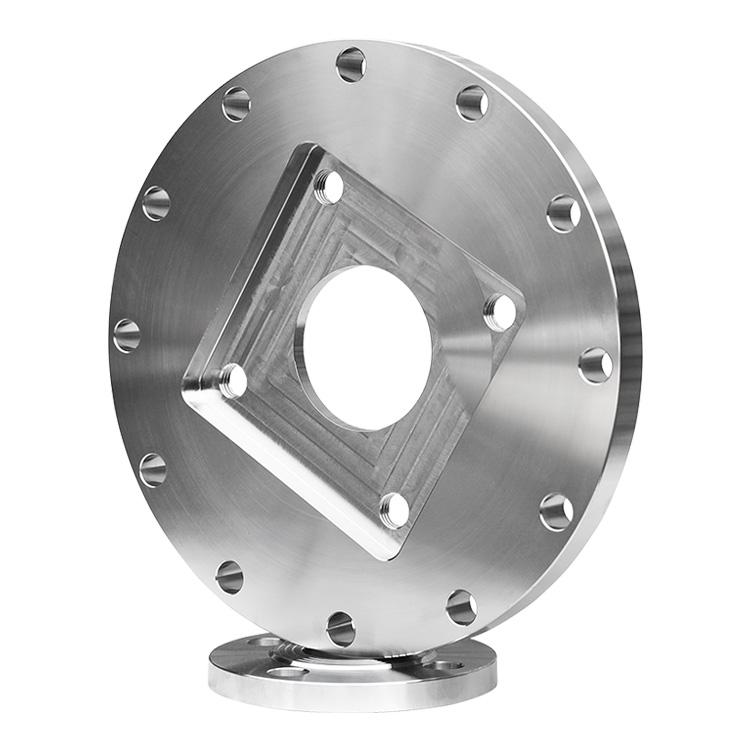
An OEM industrial pipe flange for fluid transportation systems is a critical mechanical connection component used to join pipes, valves, pumps, tanks, and other equipment in industrial piping networks. In fluid transportation systems, pipe flanges create a secure, sealable, and serviceable joint that supports the movement of liquids, gases, slurries, steam, and chemical media across a wide range of operating environments. Because fluid handling systems often require strength, pressure resistance, corrosion protection, and maintenance access, the pipe flange remains one of the most important standardized connection parts in modern industrial infrastructure.
OEM pipe flanges are produced according to customer requirements, drawing specifications, engineering standards, and application conditions. They are widely used in oil and gas, water treatment, chemical processing, HVAC, power generation, shipbuilding, food processing, pharmaceutical plants, and industrial automation systems. Compared with non-standard or ad hoc connectors, OEM flanges provide greater compatibility with system design, better dimensional accuracy, and more consistent performance in demanding operating conditions.
This guide explains the definition, functions, benefits, main types, material options, dimensional standards, technical specifications, selection factors, and common applications of OEM industrial pipe flanges for fluid transportation systems. It is designed for industrial buyers, engineers, procurement teams, and technical content pages that need SEO-friendly, original, and structured information.
An OEM industrial pipe flange is a custom-manufactured or specification-based flange component designed for original equipment manufacturers and industrial piping assemblies. It serves as a connecting interface between pipe sections or between pipes and equipment. The flange typically includes a flat circular body with bolt holes around the outer diameter and a central bore that matches the pipe size. Two flanges are joined together using bolts, nuts, and a gasket to create a tight, leak-resistant seal.
In fluid transportation systems, the flange must withstand internal pressure, external loads, vibration, temperature changes, and exposure to the transported medium. OEM pipe flanges are often produced in accordance with international standards such as ASME, ANSI, DIN, EN, JIS, or customer-specific drawings. The OEM approach allows industrial users to obtain flanges with exact material grade, size, pressure rating, surface finish, and connection style required by the application.
Because they are engineered for integration into larger systems, OEM industrial pipe flanges are used not only for direct pipeline connections but also for maintenance access, inspection points, equipment mounting, and modular piping design.
Fluid transportation systems rely on safe and efficient flow control. A weak connection can cause leakage, energy loss, contamination, pressure drop, or system failure. Pipe flanges help solve these issues by providing a strong mechanical joint that can be assembled, disassembled, inspected, and repaired without cutting the piping system apart.
In industrial operation, flanges offer several essential advantages:
For these reasons, OEM industrial pipe flanges are essential in modern fluid transportation infrastructure where uptime, safety, and performance are critical.
| Advantage | Description | Value in Fluid Transportation Systems |
|---|---|---|
| Custom Fit | Manufactured to exact drawings, standards, or system requirements | Improves compatibility and reduces installation errors |
| Strong Sealing Performance | Works with gaskets and bolts to form a tight connection | Reduces leakage and protects fluid integrity |
| Maintenance-Friendly | Can be removed and reassembled without damaging the entire pipeline | Simplifies inspection, repair, and component replacement |
| High Pressure Capability | Suitable for systems requiring stable joint strength | Supports demanding process and utility applications |
| Material Versatility | Available in carbon steel, stainless steel, alloy steel, and more | Matches fluid chemistry and environmental conditions |
| Standardized Design | Compatible with global flange standards and bolt patterns | Supports procurement and system integration |
| Durability | Engineered for long-term mechanical stability | Improves system reliability and reduces downtime |
These advantages make OEM industrial pipe flanges a preferred choice for engineers seeking dependable, cost-effective, and serviceable piping connections.
Different flange types are used depending on pressure level, installation method, alignment needs, and operating environment. Below are the most common flange types used in fluid transportation systems.
| Flange Type | Key Feature | Typical Application |
|---|---|---|
| Weld Neck Flange | Long tapered hub for stress distribution and high strength | High-pressure and high-temperature systems |
| Slip On Flange | Slides over the pipe and is welded in place | General industrial piping and lower-pressure systems |
| Blind Flange | Solid flange used to close the end of a pipeline | System termination, inspection, and pressure testing |
| Socket Weld Flange | Pipe inserts into socket before welding | Small-diameter, high-pressure piping |
| Threaded Flange | Connects to threaded pipe without welding | Low-pressure systems and maintenance-sensitive areas |
| Lap Joint Flange | Used with a stub end for easy alignment | Systems requiring frequent dismantling |
| Orifice Flange | Designed for flow measurement equipment | Instrumentation and flow monitoring systems |
| Reducing Flange | Connects two different pipe sizes | Space-saving piping transitions |
Each flange type has a specific purpose. OEM manufacturing supports all of these variants with the required tolerances, hole patterns, facing options, and pressure ratings.
Material selection is one of the most important factors in flange performance. The correct material depends on pressure, temperature, corrosion exposure, fluid composition, installation environment, and required service life.
| Material | Main Characteristics | Best Suited For |
|---|---|---|
| Carbon Steel | Strong, cost-effective, widely used | General industrial fluid systems, water, oil, steam |
| Stainless Steel | Excellent corrosion resistance and hygiene performance | Chemical processing, food, pharma, marine applications |
| Alloy Steel | Improved strength and heat resistance | High-temperature and high-pressure environments |
| Cast Iron | Economical and suitable for some utility applications | Low-pressure water and infrastructure systems |
| Duplex Stainless Steel | High strength and strong corrosion resistance | Offshore, chemical, and aggressive media systems |
| Nickel Alloy | Excellent resistance in severe chemical conditions | Highly corrosive process environments |
OEM industrial pipe flanges can also be coated, plated, or surface-treated to improve corrosion resistance, wear resistance, and appearance. Common finishes include galvanizing, epoxy coating, black oxide, and anti-rust oil treatment depending on end-use requirements.
One of the most important technical parameters for an industrial pipe flange is its pressure class. Pressure class indicates the flange’s ability to tolerate internal pressure and temperature within defined limits. In many systems, flange class is tied to standards such as ASME B16.5 or similar specifications.
| Pressure Class | General Meaning | Common Usage |
|---|---|---|
| Class 150 | Lower pressure rating for general service | Water lines, utility piping, low-pressure process systems |
| Class 300 | Moderate pressure capacity | Industrial process piping and medium-duty applications |
| Class 600 | High pressure resistance | Refinery, steam, and critical process systems |
| Class 900 | Very high pressure use | Severe-duty industrial systems |
| Class 1500 | Extra high pressure service | Specialized high-pressure fluid transport |
| Class 2500 | Extreme pressure rating | Very demanding applications with special engineering requirements |
The actual pressure capacity of a flange depends not only on class but also on material, temperature, facing type, gasket selection, bolt quality, and system design. OEM production allows the pressure rating to be matched precisely to the application.
OEM industrial pipe flanges are typically produced according to standard dimensions to ensure interchangeability and installation consistency. While exact measurements vary by standard and nominal pipe size, the technical specifications usually include outer diameter, bolt circle diameter, number of bolt holes, bore size, flange thickness, hub length, and facing type.
| Specification Item | Meaning |
|---|---|
| Nominal Pipe Size (NPS) | Standard pipe size designation used for matching flange and pipe dimensions |
| Outside Diameter (OD) | Total outer width of the flange body |
| Bolt Circle Diameter (BCD) | Diameter of the circle passing through the center of the bolt holes |
| Bolt Hole Quantity | Total number of holes used for bolted connection |
| Bolt Hole Diameter | Size of each bolt opening |
| Thickness | Material thickness of the flange body |
| Bore Diameter | Inner opening that matches the pipe or fitting |
| Facing Type | Sealing surface design such as flat face, raised face, or ring type joint |
| Hub Length | Length of the tapered or straight neck portion |
| Surface Finish | Texture or treatment of sealing and external surfaces |
These dimensions must be accurate because even small errors can affect alignment, gasket compression, and leak performance. OEM flanges are therefore often produced using precision machining and strict quality control.
The facing type refers to the sealing surface on the flange. Different facing styles are used depending on pressure, gasket type, and sealing requirements.
| Facing Type | Function | Typical Use |
|---|---|---|
| Flat Face (FF) | Completely flat sealing surface | Low-pressure systems and cast iron flanges |
| Raised Face (RF) | Raised sealing area for concentrated gasket load | Most general industrial applications |
| Ring Type Joint (RTJ) | Grooved face for metal ring gasket sealing | High-pressure and high-temperature service |
| Male-Female (M/F) | Matched sealing pair improves alignment | Specialized process systems |
| Tongue and Groove (T/G) | Interlocking surfaces improve sealing control | Critical applications with controlled gasket seating |
The correct facing type is essential for leak prevention. OEM pipe flanges can be manufactured with the facing style best suited to the fluid, pressure, and gasket design.
OEM pipe flanges are used across many industries that depend on safe and efficient fluid transport. Their role changes based on the type of fluid and the operating environment, but the core function remains the same: create a durable, serviceable, and sealed connection.
Because fluid transportation systems vary so widely, OEM production is valuable for matching flange design to real-world operating conditions.
Choosing the right OEM industrial pipe flange requires more than selecting the correct pipe size. Engineers and buyers should evaluate several technical and operational factors before purchase or production.
| Selection Factor | Why It Matters |
|---|---|
| Fluid Type | Determines corrosion risk, chemical resistance, and sealing needs |
| Operating Pressure | Influences flange class, thickness, and bolt pattern |
| Operating Temperature | Affects material expansion and pressure rating performance |
| Pipe Size | Must match nominal dimensions for proper fit |
| Connection Standard | Ensures compatibility with existing equipment and piping codes |
| Corrosion Environment | Guides the choice of material and surface treatment |
| Maintenance Frequency | Determines whether easy-disassembly flange types are preferable |
| Gasket Type | Must match flange facing and service conditions |
| Installation Space | Affects flange style selection, especially in compact systems |
A well-selected flange improves sealing reliability, reduces downtime, and increases total system efficiency.
The OEM flange manufacturing process usually involves material preparation, forging or casting, machining, drilling, heat treatment, surface finishing, inspection, and packaging. Each stage contributes to final product quality.
| Manufacturing Stage | Main Purpose |
|---|---|
| Material Selection | Choose the correct alloy or metal for the application |
| Forming / Forging / Casting | Create the flange body shape |
| Machining | Achieve accurate bore, face, thickness, and hole dimensions |
| Heat Treatment | Improve strength, hardness, and structural stability |
| Surface Finishing | Enhance corrosion protection and sealing performance |
| Quality Inspection | Verify dimensions, material integrity, and surface quality |
| Packaging | Protect flanges from damage and corrosion during shipment |
In OEM production, precision machining is especially important because flange sealing performance depends heavily on face flatness, concentricity, and bolt-hole accuracy.
Quality control is essential for industrial pipe flanges because these components are directly tied to safety and process reliability. Common inspection methods include dimensional checks, material verification, visual inspection, hardness testing, pressure testing, and surface quality assessment.
| Test or Inspection | Purpose |
|---|---|
| Dimensional Inspection | Confirms flange dimensions, hole spacing, and face accuracy |
| Material Test | Verifies chemical composition and mechanical properties |
| Visual Inspection | Detects cracks, surface defects, and machining flaws |
| Hardness Test | Confirms material response after heat treatment |
| NDT / Non-Destructive Testing | Identifies hidden internal defects without damaging the part |
| Pressure or Leak Test | Evaluates sealing integrity under operating conditions |
Good OEM suppliers follow strict quality procedures to reduce the risk of leakage, failure, and premature replacement. For fluid transportation systems, that reliability is a major purchasing factor.
From a content marketing perspective, the keyword OEM industrial pipe flange for fluid transportation systems has strong relevance for industrial directories, technical blogs, manufacturing pages, and product category pages. It combines high-intent commercial terms such as OEM, industrial pipe flange, and fluid transportation systems, making it useful for search visibility.
To improve SEO performance, content should naturally include related keywords such as:
A well-structured page with definitions, specifications, tables, and application examples is easier for search engines to understand. It also improves user experience by helping engineers quickly find technical details.
| Item | Common Range or Option | Notes |
|---|---|---|
| Size Range | Small bore to large diameter | Depends on system design and standard |
| Pressure Class | Class 150 to Class 2500 | Selected based on pressure requirement |
| Material | Carbon steel, stainless steel, alloy steel, duplex, cast iron, nickel alloy | Chosen according to media and environment |
| Facing | FF, RF, RTJ, M/F, T/G | Matched to gasket and sealing conditions |
| Connection Method | Welded, threaded, socket weld, bolted | Depends on flange type |
| Surface Finish | Machined, coated, galvanized, anti-rust treated | Supports protection and sealing |
| Standards | ASME, ANSI, DIN, EN, JIS, custom OEM | Ensures dimensional compatibility |
| Operating Medium | Water, oil, gas, steam, chemicals, slurry | Determines material compatibility |
| End Use | Pipeline, equipment, pump, valve, vessel connection | Supports many industrial systems |
Large-scale fluid systems demand consistent component quality. OEM flanges help ensure that every connection point meets the same engineering criteria. This consistency is especially valuable in complex networks where hundreds or thousands of flange joints may be installed.
These benefits make OEM pipe flanges highly valuable for industrial users focused on performance, safety, and total cost of ownership.
An OEM industrial pipe flange for fluid transportation systems is more than a simple connector. It is a precision-engineered component that supports safe, efficient, and maintainable fluid movement across many industries. With the right material, standard, facing, pressure class, and manufacturing quality, a pipe flange can deliver reliable sealing and long service life in demanding operating conditions.
Whether used in water distribution, chemical transfer, oil and gas pipelines, power plant utilities, or hygienic process lines, OEM industrial pipe flanges play a central role in maintaining system performance. Their standardized yet customizable design makes them an essential part of modern fluid transportation infrastructure.
For SEO-focused industrial pages, this topic offers strong keyword potential, broad application relevance, and clear technical structure. A well-organized page with tables, definitions, and application details can help improve search visibility while providing real value to engineers, buyers, and technical readers.
```


Copyright © 2022 Zhejiang Songlin Flange Co., Ltd.
Mapa del sitioEste sitio web utiliza cookies para garantizar que obtenga la mejor experiencia en nuestro sitio web.

 English
 Pусский
 Français
 Deutsch
 日本語
日本語 한국어
한국어 العربية
 Italiano
 Nederlands



 Whatsapp
 Teléfono
Comentario
(0)